


You are standing in a cool stone building, guidebook open, trying to work out what you are actually looking at. The sign says abbey. Or priory. Or cathedral. In everyday speech the three words get used as if they all mean "big old church," and the building itself often gives nothing away — there are tiny cathedrals and enormous priories. The real differences lie in who governed the place and how the people inside it spent their days. Those two things shaped the walls, the plan and the furniture. Ask three questions of any religious building and you can usually place it within a minute.
The Short Answer
An abbey is a monastery: a house where a community of monks or nuns lives under a rule, headed by an abbot or abbess. A priory is also a monastery, but one of lower rank or dependent status, headed by a prior or prioress. The umbrella term for both is "monastery" — abbey and priory describe its rank and governance, not its style of architecture.
A cathedral is something else entirely. It is the church that contains a bishop's official seat, the cathedra, Latin for chair. That is the whole test. A cathedral can be vast like Durham or modest like a small town church that happens to be a bishop's home base. What makes it a cathedral is the bishop, not the size, the age or the beauty of the building.
Governance: Who Held Authority
Authority is where the three types pull apart most sharply.
- Abbey — ruled by an abbot or abbess, usually elected by the community and often serving for life. An abbey could be largely self-governing, answering to its order, its bishop or, in some cases, directly to Rome.
- Priory — ruled by a prior or prioress. Many priories were daughter houses: a monastery founded by an abbey, with a prior appointed by the abbot and no independent authority of its own. Cluniac priories are the classic example, all answering to the abbot of Cluny. Other priories, particularly among the Augustinian canons, were fully independent and headed by a prior simply because that was the custom of the order.
- Cathedral — ruled by a bishop, assisted by a chapter of clergy. In England the usual arrangement was a dean and chapter of canons, men who were not monks and who often lived in their own houses within the cathedral close.
The overlap trips people up. Several English cathedrals — Canterbury, Durham and Winchester among them — were also monasteries. The bishop was nominally abbot, while a prior ran the daily life of the monks. So a single building could be, and was, both a cathedral and a priory.
Architecture: What the Stones Reveal
Styles changed with fashion, so Gothic or Romanesque tells you about dates rather than function. The floor plan is the better clue.
The cloister is the giveaway
Abbeys and priories were built around a cloister, a square open space with covered walkways on each side. Around it clustered the buildings that made the house work: chapter house for meetings, refectory for meals, dormitory for sleep, infirmary, kitchens, store rooms, sometimes a warming room where the community could thaw out. The church itself was only one part of a working complex, which is why ruined abbeys today look like a village without a village.
Cathedrals are organised around worship and ceremony. Look for the bishop's throne, generally placed in the choir, and for a long nave built to hold processions and crowds. Cathedrals have chapter houses too, because the canons needed somewhere to meet, so a chapter house on its own does not prove that monks lived there. If you find a cloister, refectory and dormitory range attached, you are looking at monastic ground.
Daily Life: Two Rhythms
Monastic life ran on the Divine Office, sung at fixed hours: Matins and Lauds before dawn, then Prime, Terce, Sext, None, Vespers, and Compline to close the day. Between the offices came manual work, copying, study and hospitality to travellers. Meals were taken together in silence, possessions were limited, and enclosure kept the world at arm's length. With Compline came the Great Silence, after which speech stopped until morning.
Cathedral canons prayed a similar round of offices, but the resemblance stops there. Many lived in separate houses with their own servants and households rather than in a common dormitory, and their duties included administration, estates and preaching. A monastery was a family under one roof. A cathedral chapter was closer to a committee of clergy with a shared rota.
For visitors, the practical result is that the nave — the public part — was often all a lay person ever saw. The choir and cloister belonged to the community.
Places That Break the Rule
Names survive long after the institutions do, which is why so many buildings are labelled one thing and function as another.
- Westminster Abbey was a Benedictine monastery but is not a cathedral. It is a "royal peculiar," a collegiate church under the monarch, run by a dean and chapter. You will find no abbot there.
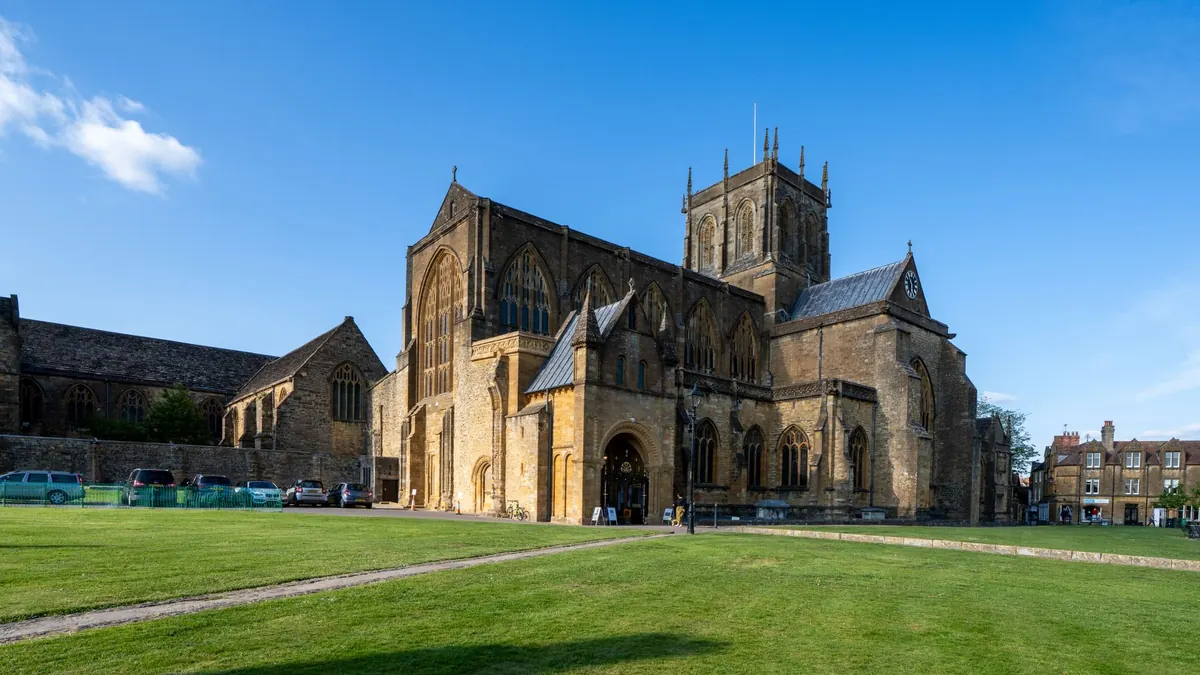
- Bath Abbey, Tewkesbury Abbey and Sherborne Abbey are former monastic churches now serving as parish churches, keeping the title for old times' sake.
- Christchurch Priory in Dorset is a large, grand priory church — proof that grandeur is no guide to rank.
- Fountains and Rievaulx are Cistercian abbeys that are now ruins, so the "abbey" is a place, not a person.
- Woburn Abbey is a country house, never a monastery.
- A minster was originally a church served by a community of clergy. Some minsters are cathedrals, like York; others are simply historic churches.
A Visitor's Quick Test
- Is there a bishop's throne? If yes, you are in a cathedral, whatever the sign outside says.
- Is there a cloister with a refectory and dormitory range? That points to an abbey or priory.
- Does anyone live here now? Resident monks, nuns or friars keep the monastic pattern going; many former abbeys are simply parish churches with no community.
- Read the leaflet for the words "dean and chapter" — that means cathedral governance. "Abbot" or "prior" means monastic.
- Check the parts you may enter. In houses with a living community, the church may be open only at set hours and the cloister may be off limits.
If you are still unsure, ask whoever greets you at the door a single question: who runs this place? The answer — a bishop, a dean, an abbot, a prior, or a parish priest — settles it faster than any guidebook.
Photo: Phil Ledwith / Pexels
Related posts
More stories you’ll love reading